Cheat-Proof Chemistry Labs
Rethinking "Unauthorized Collaboration"
All out-of-class assignments are inherently vulnerable to unauthorized collaboration. Preventing it is nearly impossible, and detecting it is often time-consuming and frustrating. Instead of fighting a losing battle, a more effective approach is to rethink the goal.
If the true objective of these assignments is student learning, then we should design, and implement, a system that accepts - even encourages - collaboration while still ensuring that learning takes place.
Learning, after all, is defined as a change in long-term memory. If long-term memory has not been altered, then learning has not occurred.
How Can We Support Both Collaboration and Learning?
The solution is simple: allow collaboration - but verify learning individually.
Step 1: Encourage Collaboration
Inform students that they are allowed to work together on the out-of-class lab report. Emphasize that the purpose of collaboration is to understand how to solve the problems - not just to obtain correct answers.
Step 2: Assess Individual Learning
At the beginning of the next lab period (10 minutes), administer a timed calculation quiz:
- Students log in to Chem21Labs
- They access a condensed version of the previous lab report
- They perform calculations, balance equations, draw structures, etc. Lab data values appear as randomized numbers
Because the structure is familiar, students who truly understood the process can complete the work independently.
Grading Structure
To reinforce the importance of learning over copying:
- Out-of-class lab work: ~30%
- In-class timed quiz over previous lab: ~30%
- Remaining components (40%):
- Pre-lab assignments
- Safety and cleanup
- Lab Results
- Post-lab assignments
This balanced weighting ensures that simply copying answers is not enough - students must demonstrate real understanding.
The Outcome
This approach shifts the focus from × "Getting the correct answer" to ✓ "Learning how to get the correct answer"
Instead of policing collaboration, instructors redefine it as part of the learning process. Students are encouraged to engage with peers, build understanding, and then demonstrate that knowledge independently.
Bottom Line
Rather than trying to eliminate unauthorized collaboration - a nearly impossible task - this strategy changes the rules entirely.
It creates a system where:
- Collaboration is productive
- Expectations are clear
- Accountability is individual
- Learning is measurable
A true win-win for both students and instructors.
The Coach Approach
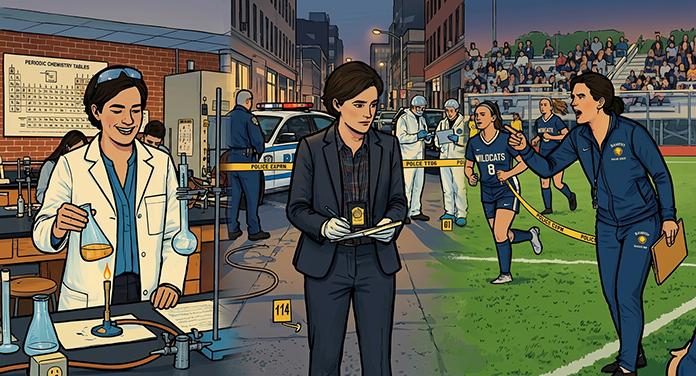
The strategy described above is called the Coach Approach. Every teacher chooses to be:
- A traditional chemistry teacher (like the one we learned from)
- A detective investigating cheating
- A coach of the winningest chemistry team
. . . . or a "hybrid" of the first two.
The Coach Approach emphasizes guidance, practice, and performance - helping students develop the skills they need to succeed independently.