

TRQ Research
Organic Chemistry
The American Chemical Society (ACS) Organic Exam has been given as the Spring Final for Organic Chemistry II at Lee University (Cleveland, TN) since 1991. Starting in 2005, TRQs were used in both semesters of Organic Chemistry. In the first fifteen years (1991 - 2005), the class average on the ACS Organic Exam was 41 percentile . . . . in the next twelve years (when TRQs were used), the class average was 59.4 percentile . In addition, only thirteen students in the first fifteen years scored above the 90th percentile on this exam. From Spring 2006 - Spring 2017, forty-six students scored above the 90th percentile. Click the Play button in the interactive graph below to start the animation . . . . stop at any point by clicking the Stop button.
Equally remarkable is the fact that in the last twelve years of the study, only three students (3/389) that started Organic II in January failed to take the ACS Exam in May. In contrast, 15% (37/248) of the students in the first fifteen years withdrew from the class and did not take the ACS Final. This longitudinal study suggests that the TRQ learning method significantly helps the under-prepared students (based on exceptionally low attrition rates and higher end-of-course grades). Additionally, TRQs provide a significant benefit to the "prepared" students as evidenced by the increase in the number of students scoring above the 90th percentile.
How is this possible in a class like Organic Chemistry?
It is entirely based on the learning approach described by Skinner where students are asked to complete "small steps" - steps that every student can successfully complete in a short span of time. After a large number of small steps, the student has traveled a vast academic distance. The Organic students at Lee University were given a few "small steps" to complete on the first day of the first semester and on most other days throughout the academic year. Students that did not complete the TRQ part of the class were simply not willing to work on the simplest academic task . . . . they refused to take a tiny step that any learner can complete.
Mathematics - Ocoee Middle School
In 2011 - 2012, TRQs were used by 78 students in a 6th grade math class for 20% of the instructional time - the teacher condensed her previous classroom activities into the remaining 80%. On average, the 78 students showed a 12.8 percentile increase in the state's end-of-class exam (TCAP). The fourth row in the animated graph shows that 43.7% of the students arriving from the 5th grade were classified as Proficient / Advanced , the remaining 56.3% were Basic or Below Basic . After using the Math TRQs for their 6th grade year, 63.4% of these test students performed at the Proficient / Advanced level on this exam - an increase of 19.7%. As expected, the improvement in TCAP was most noticeable for the Below Basic (+26.5 %-ile) and Basic (+16.5 %-ile) math students.
Also in 2011 - 2012 and again in 2012 - 2013 at OMS, the TRQs were used in a "Response To Intervention (RTI)" class comprised of only Basic Math Students as determined by their previous year's TCAP score in Math. In addition to their daily 90-minute Math class, students attended the RTI class for 45 minutes every day for 1 semester where they exclusively used TRQs. There were ~ 140 students in RTI classes each semester . . . . of the 557 RTI students in 2011 - 2013, 197 students (35.4 %) moved up to the Proficient / Advanced level on the state's TCAP exam.
A common question is . . . . How many TRQs are too many TRQs?
In the first year of the study (2011 - 2012), 24 students used TRQs 90 minutes per week (20% of instructional time) as members of the 78-student 6th grade math class and 45 minutes each day for 1 semester as members of the "RTI" math class . . . . on average for the year, these 24 students spent 202.5 minutes each week on TRQ assignments. While ~35% of students in the RTI cohort moved to the Proficient / Advanced , 12/24 (50%) of the students that experienced this "double exposure" to the TRQ method moved from the Basic level to the Proficient / Advanced levels. One can postulate that the difference between a Basic student and a Proficient / Advanced student is their knowledge base . . . . if you have facts, you have a greater ability to solve higher-order, more complex problems in class and on a TCAP-like exam.
How many TRQs are too many TRQs? This is not a major concern because once students become proficient, recertifying on the material typically takes about one minute. Even assigning 100 unnecessary TRQs in a semester would add only about 100 minutes of extra work.
Mongolian Language Study
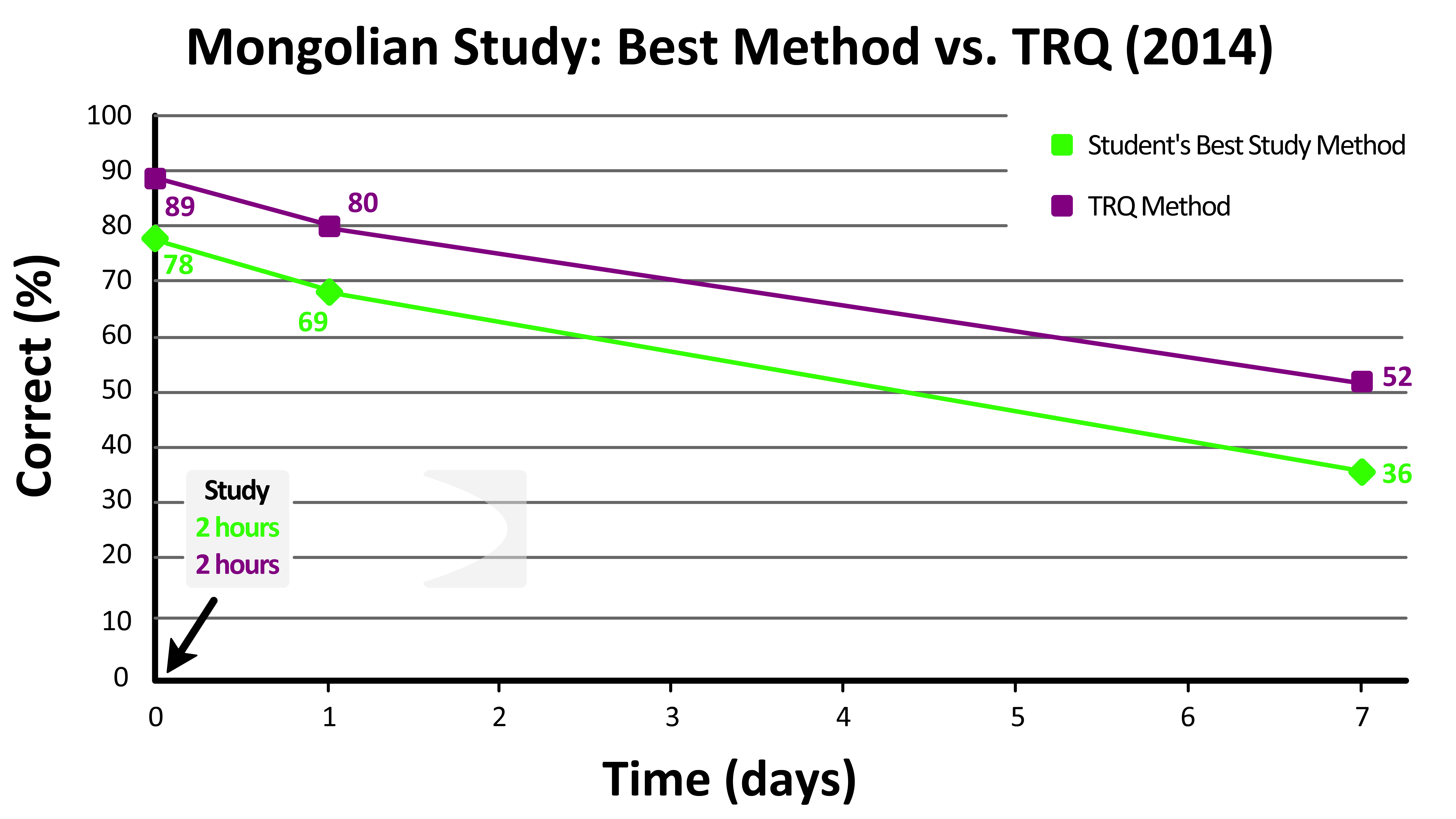
In April 2014, 19 students from an Organic Chemistry II and upper-level Psychology (Learning and Cognition) course participated in a study on learning methods.
On the first day, students studied 50 Mongolian words for two hours using their preferred study strategy. Their ability to spell the Mongolian word when given the English equivalent was tested after 2 hours, 24 hours, and 1 week.
Twenty-four hours later, students studied a different set of 50 Mongolian words for two hours using the TRQ method, followed by the same assessments.
Mongolian was chosen because none of the participants had prior knowledge of the language.
Results showed that immediately after studying, students using TRQ recalled 14.5% more words than when using their preferred method. After 24 hours and 1 week, TRQ performance was 16.0% and 44.0% higher, respectively.
The 1-week loss of 53.5% of words learned using the student's best method and 41.5% of words using the TRQ Method, shows the benefits of retrieval practice (the suggest implementation method) for moving information into long-term memory and keeping it there longer.
Note, that using the TRQ method for 2 straight hours is not the prescribed method of implementation, but we were interested in a direct comparison of the student's best learning method and the TRQ method. When properly administrated, spaced TRQ repetition transforms Ebbinghaus' Forgetting Curve into a Remembering Curve. Ebbinghaus discovered that information learned in one study session decreases by half with each passing day - over 95% of this retained information has vanished in 1 week. Click the Play button in the animation (right) to see how TRQs transform the learning process . . . . each spaced TRQ repetition () progressively flattens the forgetting curve.
Spanish Language - Medical Missions
In May 2014, twenty-three university students participated in a Medical Missions trip that required an International Health course. One-third of the course grade was a Spanish language component where the students used TRQs to learn 1000 words / phrases. The content was divided into 26 TRQ assignments requiring six spaced repetitions over three weeks.
The results are from the Nouns 1 TRQ, consisting of 37 questions. Each TRQ quiz presented 25 (of the 37) English words, and the students were required to correctly spell the Spanish equivalent, including accent marks.
Based on their performance on Nouns 1 Set 1, students were divided into three learning groups:
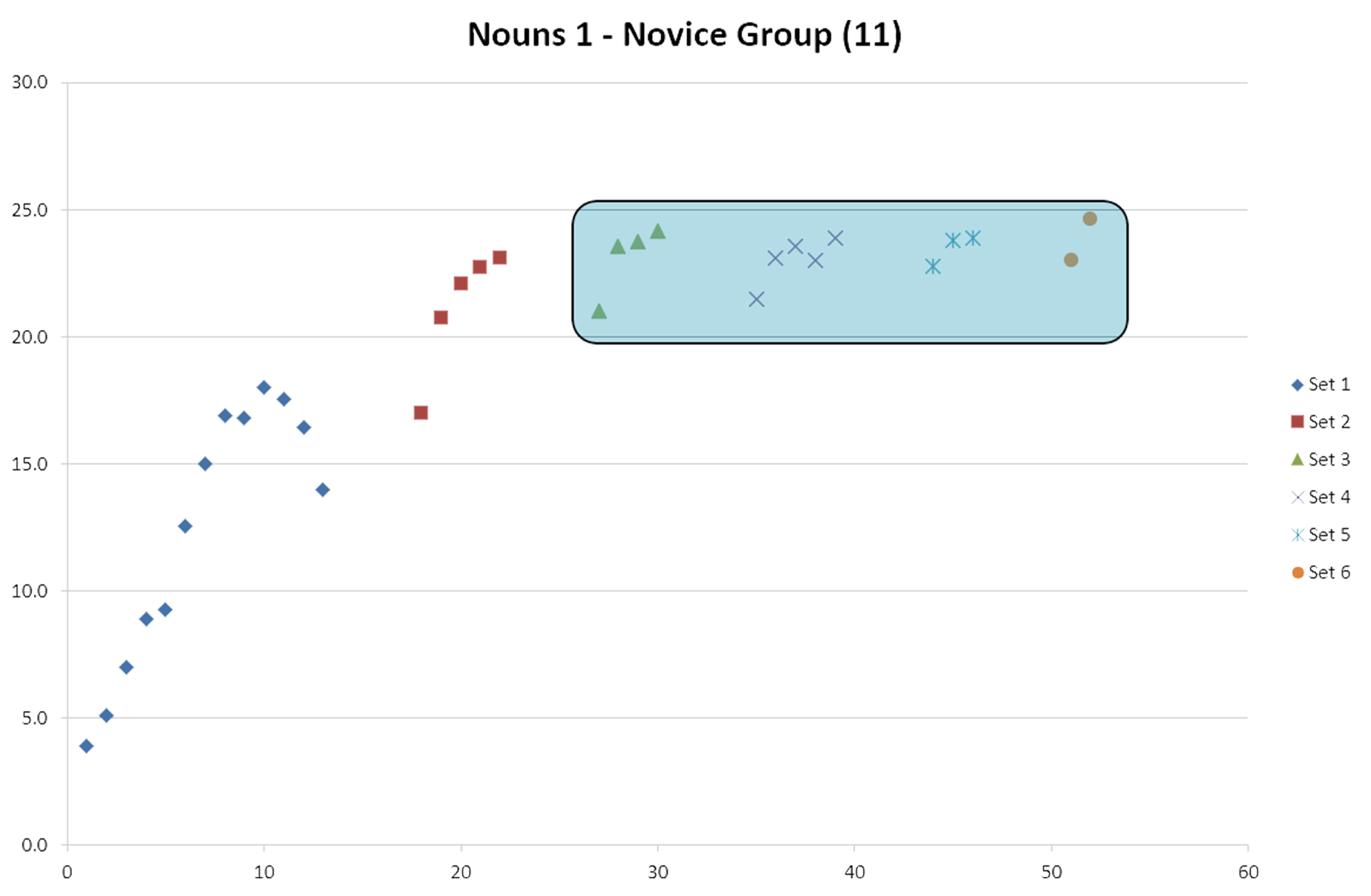
- Novice Group (11 students): the average score on the first four quizzes was less than 10 correct answers.
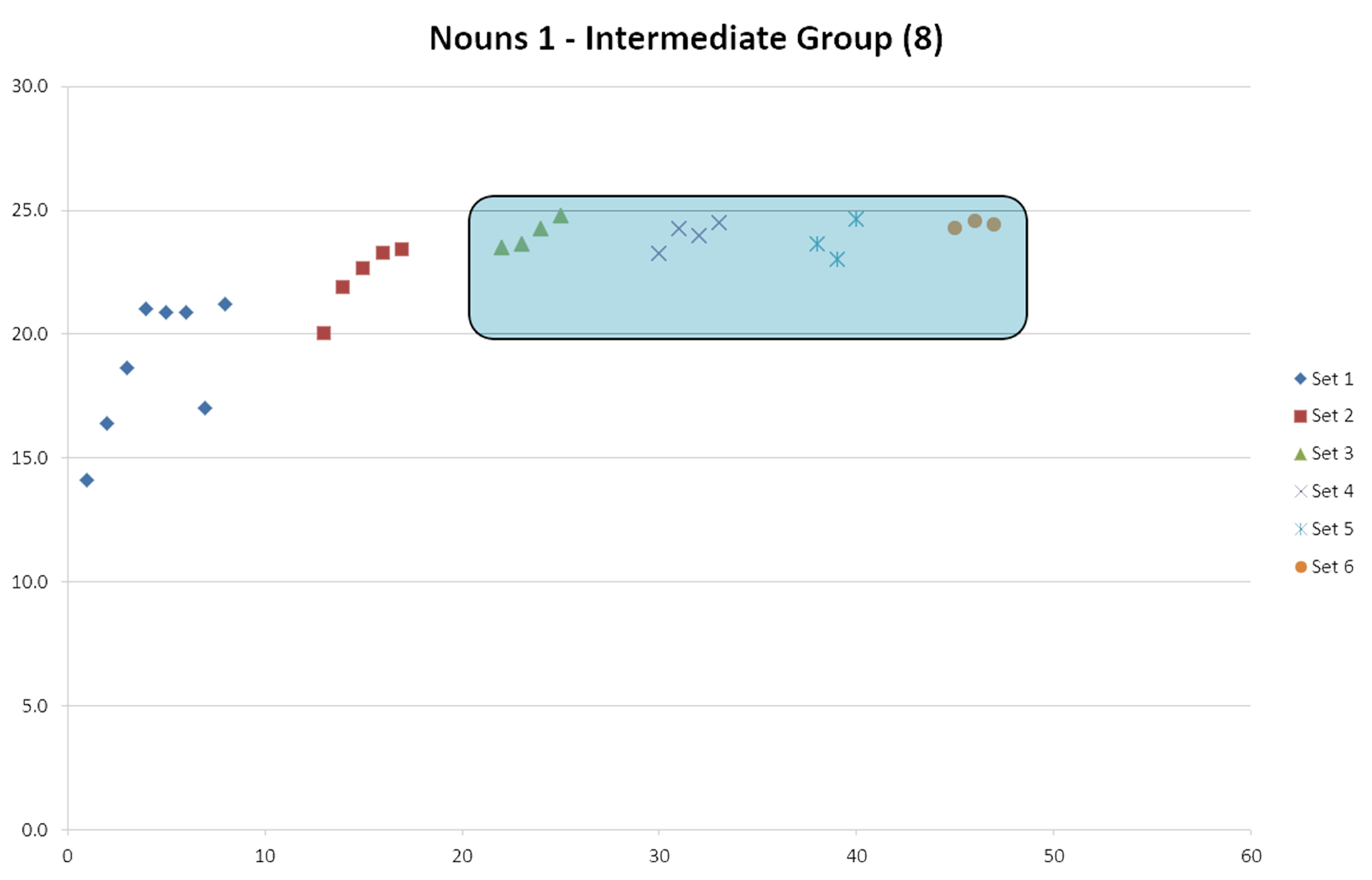
- Intermediate Group (8 students): the average score on the first four quizzes was between 10 and 20 correct answers.
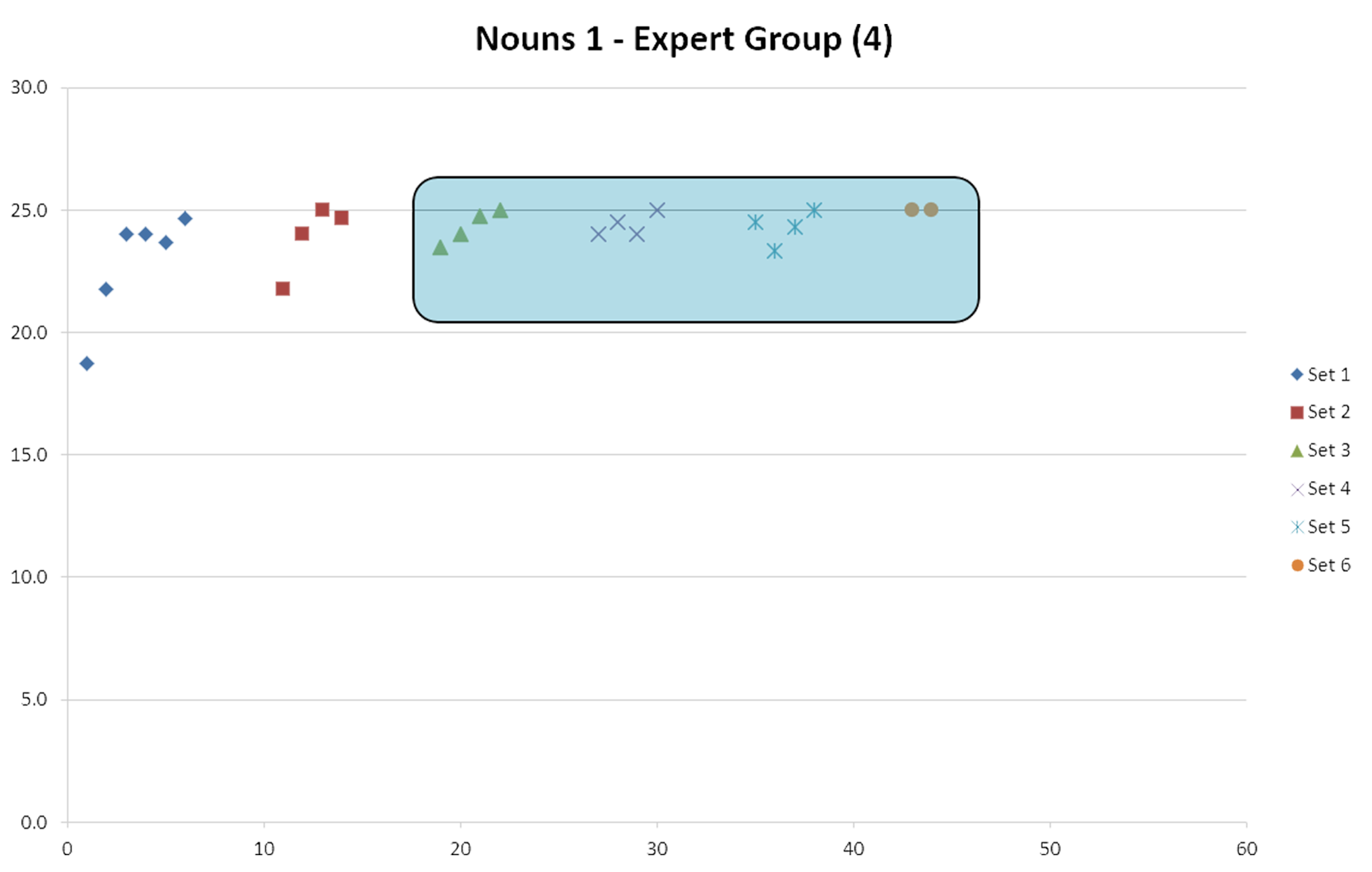
- Expert Group (4 students): the average score on the first four quizzes was between 20 and 25 correct answers.
A deeper look into the Nouns I assignment reveals an unexpected result. The best presentation is seen in the graphs to the right. Each graph displays a group's average number of correct answers . . . . for example, each data point on the Novice graph represents the average number of correct answers on a single quiz for the 11 novice students.
Surprisingly, after just two TRQ sets, the three groups became indistinguishable. Despite starting with very different knowledge levels, novices quickly caught up to experts at a remarkable pace. The shaded areas highlight the last four TRQ Sets and the fact that each group completed the last four TRQ Sets in exactly 14 quizzes.
In many classrooms, teachers introduce basic facts and quickly move to guided or collaborative activities. However, these results suggest that more than half of students (the Novice group) lack enough initial knowledge to participate effectively after a simple introduction. In this study, novices "knew" 72% of 37 Spanish nouns after the first TRQ set and 92% after the second, indicating that requiring at least two TRQ sets before teacher-led activities could significantly improve learning outcomes.
If you are interested in using TRQs in General Chemistry
or Organic Chemistry, please contact support@chem21labs.com.